What is lateral epicondylitis (tennis elbow)?
Lateral epicondylitis (tennis elbow) is the name for a condition in which the bony bump at the outer side of the elbow is painful and tender.
The elbow joint is made up of the bone in the upper arm (humerus) and one of the bones in the lower arm (ulna). The bony bumps at the bottom of the humerus are called epicondyles. The bump on the outer side of the elbow, to which certain forearm muscles are attached by tendons, is called the lateral epicondyle.
Lateral epicondylitis is also referred to as wrist extensor tendonitis.
How does it occur?
Tennis elbow results from overusing the muscles in your forearm that straighten and raise your hand and wrist. When these muscles are overused, the tendons are repeatedly tugged at the point of attachment (the lateral epicondyle). As a result, the tendons become inflamed. Repeated, tiny tears in the tendon tissue cause pain. Among the activities that can cause tennis elbow are tennis and other racket sports, carpentry, machine work, typing, and knitting.
What are the symptoms?
The symptoms of tennis elbow are:
- pain or tenderness on the outer side of the elbow
- pain when you straighten or raise your wrist and hand
- pain made worse by lifting a heavy object
- pain when you make a fist, grip an object, shake hands, or turn door handles
- pain that shoots from the elbow down into the forearm or up into the upper arm.
How is it diagnosed?
We will ask you about your daily and recreational activities. We will examine your elbow and arm and will have you do movements that may cause pain in the outer part of your elbow. We may also order x-rays of the elbow.
How is it treated?
Treatment includes the following:
- You can also do ice massage. Massage your elbow with ice by freezing water in a Styrofoam cup. Peel the top of the cup away to expose the ice and hold onto the bottom of the cup while you rub the ice over your elbow for 5 to 10 minutes.
- Wear a tennis elbow strap. This strap wraps around the forearm below the elbow, acting as a new attachment site for the forearm muscles and keeping them from pulling on the painful epicondyle.
- Take anti-inflammatory medicine.
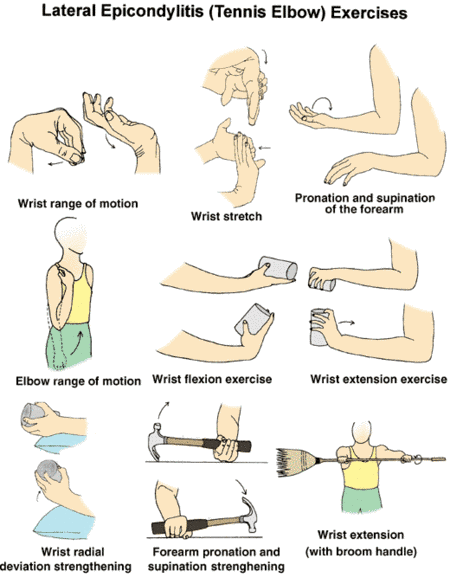
- Do the exercises recommended by your health care provider. Your provider may also recommend physical therapy.
- We may recommend an injection of a corticosteroid medicine around the lateral epicondyle to reduce the inflammation.
- In severe cases, surgery may be recommended.
While you are recovering from your injury you will need to avoid repetitive motion of the elbow and to change your sport or activity to one that does not make your condition worse. For example, you may need to run instead of play tennis. If you play tennis, we may advise you to use a tennis racket with a larger grip. We may suggest improvements in the way you hold or swing your racket. Try to lift objects with your palm facing up to keep from overusing your lateral epicondyle.
How long will the effects last?
The length of recovery depends on many factors such as your age, health, and if you have had a previous injury. Recovery time also depends on the severity of the injury. A mild injury may recover within a few weeks, whereas a severe injury may take 6 weeks or longer to recover. This problem can sometimes be long-lasting and can even come back once you are better. You need to stop doing the activities that cause pain until your elbow has healed. If you continue doing activities that cause pain, your symptoms will return and it will take longer to recover.
When can I return to my normal activities?
Everyone recovers from an injury at a different rate. Return to your activities will be determined by how soon your elbow recovers, not by how many days or weeks it has been since your injury has occurred. In general, the longer you have symptoms before you start treatment, the longer it will take to get better. The goal of rehabilitation is to return you to your normal activities as soon as is safely possible.
You may return to your sport or activity when you are able to forcefully grip things, like a tennis racket or golf club, or do activities such as working at a keyboard without pain in your elbow. It is important that there is no swelling around your injured elbow and that it has regained its normal strength compared to your uninjured elbow. You must have full range of motion of your elbow.
How can I prevent tennis elbow?
To prevent tennis elbow:
- Use proper form during your activities, whether they are sports or job-related. For instance, be sure your tennis stroke is correct and that your tennis racket has the proper grip size.
- Warm up before playing tennis or doing other activities that involve your elbow or arm muscles. Gently stretch your elbow and arm muscles before and after exercise.
- Ice your elbow after exercise or work.
- In job-related activities, be sure your posture is correct and that the position of your arms during your work doesn’t cause overuse of your elbow or arm muscles.
Exercises for Tennis Elbow
 Dr Vaibhav Bagaria